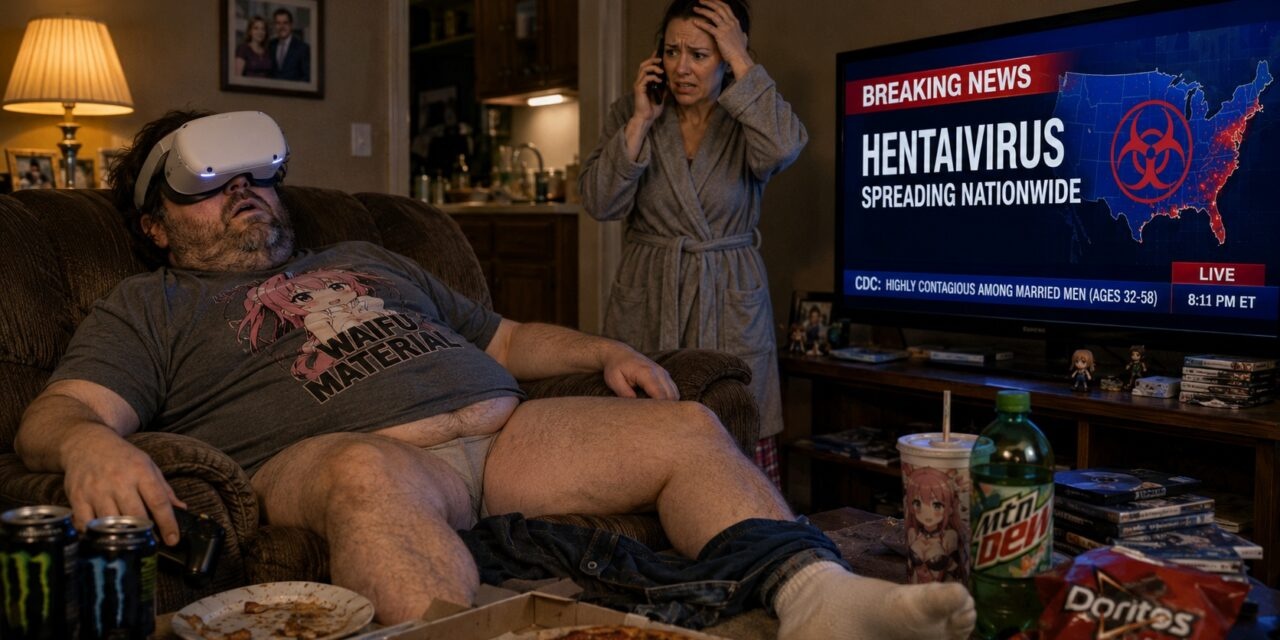
OUTHOUSE DAILY HEALTH DESK — The Centers for Disease Control has declined to comment on the rapidly spreading condition known online as Hentaivirus, despite mounting anecdotal evidence that it has already claimed thousands of wallets, marriages, and dignity points.
Experts believe the disease begins innocently enough.
“It usually starts with someone saying, ‘I’ll just watch one episode to see what all the fuss is about,’” explained absolutely no medical professional whatsoever.
Within weeks, sufferers may begin displaying increasingly severe symptoms.
Common Symptoms
- Spending more on imported anime merchandise than your retirement account.
- Buying overpriced anime and JRPG-themed swords from obscure websites despite having no enemies outside the comments section.
- Gathering an alarming number of waifu pillows while insisting each one has “a different personality.”
- Becoming irrationally upset whenever someone refers to anime as “cartoons.”
- Watching The Last Samurai and swearing they were a famous Edo-period samurai in a previous life.
- Ordering sake at completely normal bars, then politely—but relentlessly—lecturing the bartender on proper serving temperatures.
- Developing a sudden fascination with Godzilla, drifting, Japanese vending machines, and convenience stores.
- Referring to convenience stores exclusively as konbinis.
- Secretly judging strangers for improper chopstick technique.
- Saying “arigato” to Mexican waiters.
- Purchasing a katana despite living in a one-bedroom apartment.
- Believing moving to Japan will magically solve every problem in life, including poor credit.
- Telling everyone that subtitles are objectively superior while pretending not to care what others think.
- Attempting to go Super Saiyan in the bathroom mirror when absolutely certain nobody is watching.
Advanced-Stage Symptoms
Medical researchers (again, not actual ones) report additional warning signs in untreated patients:
- Randomly inserting Japanese words into otherwise English sentences, desu.
- Correcting other people’s pronunciation of “karaoke,” then their pronunciation of “Mario,” then their pronunciation of “Nissan.”
- Explaining, for the fourth time at one dinner, the difference between a wakizashi and a katana to people who did not ask and are actively leaving.
- Owning a kotatsu in a climate that has never once required one.
- Maintaining a “seasonal watch list” with the rigor most people reserve for organ-transplant schedules.
- Referring to their commute as their “arc.”
- Describing a mild inconvenience at work as “filler.”
- Bowing slightly during video calls and then having to pretend they were stretching.
- Insisting their cat understands Japanese.
- Having strong, unsolicited opinions on which Hokage was the best Hokage.
- Beginning sentences with “Well, in the manga…”
- Owning more headbands than situations that call for headbands.
At-Risk Populations
The CDC has not identified high-risk groups, on account of refusing to return any of our calls. However, our health desk has independently determined the following populations to be especially vulnerable:
- Anyone who has ever described a body pillow as “low-maintenance.”
- Adults who learned to count to ten in Japanese before they learned to do their own taxes.
- People who own a vehicle with more anime decals than functioning brake lights.
- Individuals who can name forty-seven sword-fighting techniques but cannot name their congressman.
- Anyone currently nodding and thinking “this is actually pretty accurate” while feeling personally attacked.
Transmission
Hentaivirus is believed to spread primarily through enthusiasm. A single infected individual can compromise an entire friend group simply by saying, “Okay but hear me out, this one’s different,” while queuing up the first episode.
Secondary transmission vectors include conventions, the algorithm, that one coworker, and any roommate who owns a projector.
There is no known case of someone watching “just the one episode.”
Treatment
There is currently no cure. Treatment focuses on managing symptoms and protecting the patient’s remaining savings.
“We recommend confiscating the patient’s credit cards and slowly reintroducing live-action television,” said a man we are fairly sure was just the building’s HVAC technician. “In severe cases, we suggest a gentle intervention, ideally before the second katana arrives.”
Families are urged to watch for relapse, which typically presents as the phrase “I’m getting back into it, but only the good stuff this time.”
A Message of Hope
While the outlook may seem grim, the health desk wishes to remind readers that millions of sufferers go on to lead full, productive lives, provided no one ever lets them near a duty-free shop in the Tokyo airport.
If you or a loved one is exhibiting these symptoms, do not panic. Sit them down. Speak gently. And whatever you do, do not—under any circumstances—ask them what “isekai” means.
You will not get those four hours back.
The Outhouse Daily Health Desk is not staffed by medical professionals, licensed practitioners, or anyone who finished the course. Consult a real doctor about real things. Consult no one about which Hokage was best; that debate has no survivors.